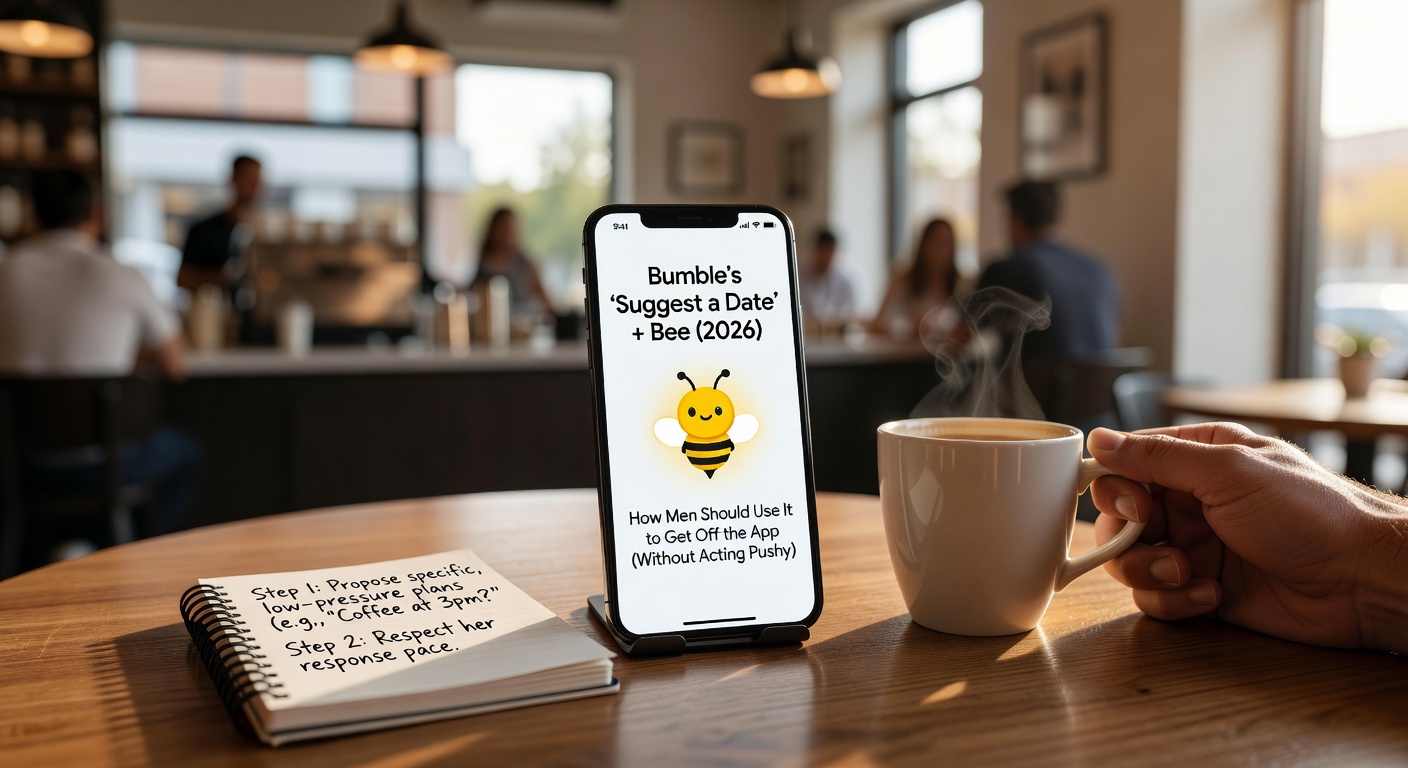
Bumble’s “Suggest a Date” + Bee (2026): How Men Should Use It to Get Off the App (Without Acting Pushy)
Bumble’s “Suggest a Date” + Bee (2026): How Men Should Use It to Get Off the App (Without Acting Pushy)
Bumble quietly admitted what most guys already know: the match isn’t the problem — the stall is.
On February 26, 2026, Bumble announced two new product moves designed to reduce friction and create “clarity” in dating: Profile Guidance and Suggest a Date (currently being tested in Canada). The message is simple: people are matching, then doing nothing — and Bumble wants more conversations to turn into real-life plans. (ir.bumble.com)
At the same time, Bumble has been piloting an assistant-driven experience called Dates, powered by Bee — a mode designed to move you from match to meeting with less swipe fatigue. As of March 30, 2026, Bumble says this is only available to a small set of invited members in NYC, and it works by asking you questions (values, preferences) and then notifying you when Bee finds a potential match — no swiping required. (support.bumble.com)
This article is DateWise-style: anti-PUA, practical psychology, and a field-tested way to use these features like a normal man who actually wants dates.
What Bumble Changed (and Why You Should Care)
1) Suggest a Date: Bumble is nudging people to “declare intent”
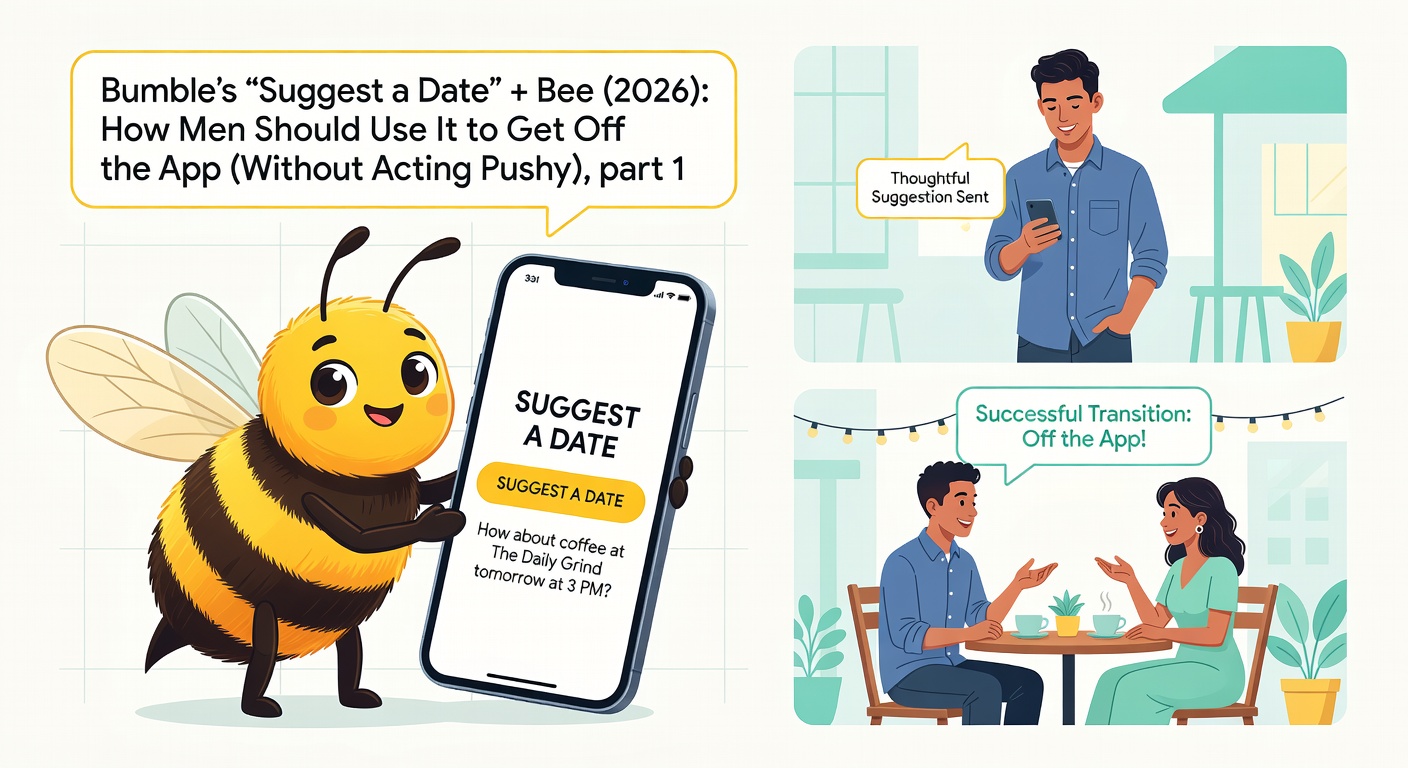
Bumble’s press release frames Suggest a Date as a tool to make it easier to signal you want to meet in person — especially when chats stall. It’s basically an in-app “let’s stop circling and pick a plan” button. (ir.bumble.com)
Why that matters for men:
- Bumble is trying to reward follow-through, not endless texting.
- Women on apps are increasingly filtering for clarity + safety + effort.
- The “cool, vague, maybe-sometime” approach is dying.
2) Dates, powered by Bee: Bumble experimenting with “less swiping, more curation”
Bee asks you questions about values and relationship preferences, then does the searching for you and pings you when it finds someone. (support.bumble.com)
Translation: Bumble is moving toward matchmaking + coaching, not just a swipe marketplace.
This shift mirrors what other apps are doing: reduce friction, reduce dead chats, and reduce bot energy.
The Real 2026 Context: Trust Is the New Attraction
In 2026, women don’t need you to be clever. They need you to be credible.
That’s partly because apps are tightening identity systems. For example, Tinder expanded its facial verification onboarding feature (Face Check) for new users in the U.S. in late 2025, and Match Group indicated it would roll out across other apps in 2026. (techcrunch.com)
Even if you never touch Tinder, the culture shifts:
- People assume more fake profiles.
- People assume more AI-written messages.
- People bail faster when intent is unclear.
So Bumble building “clarity” features isn’t random. It’s an adaptation to a trust problem.
The DateWise Rule for These Features
Here’s the core principle:
Use Bumble’s new tools to remove friction — not to replace your backbone.
If you’re the guy who hesitates too long, Suggest a Date can help.
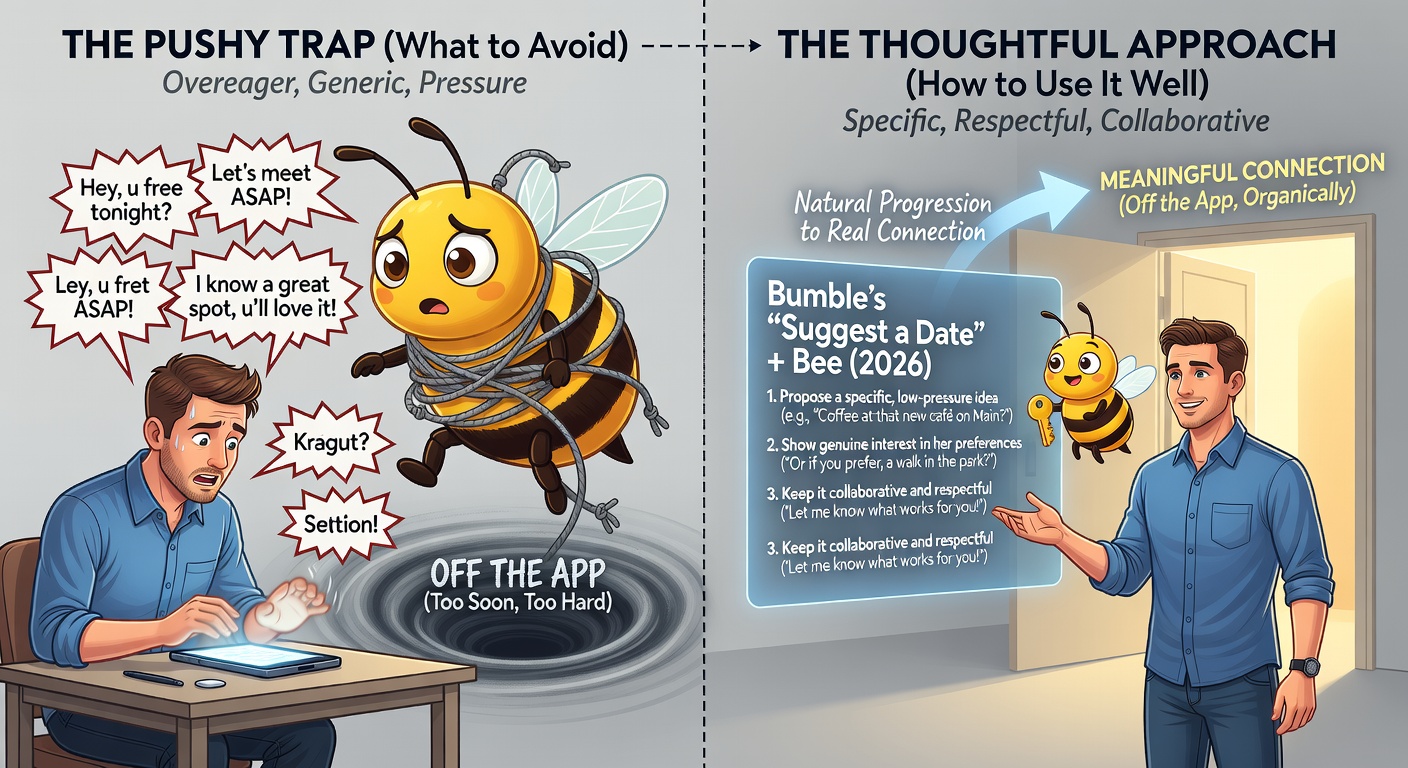
If you’re the guy who pushes too hard, it can make you look worse.
The winning move is still:
- specific
- low-pressure
- time-bounded
- logistically clean
How to Use “Suggest a Date” Without Sounding Pushy
The easiest way to become pushy is to treat the feature like a shortcut to compliance.
Don’t.
Treat it like a momentum tool after you’ve established basic comfort.
When to use it (the timing that doesn’t kill attraction)
Use Suggest a Date when at least one of these is true:
- She replied with energy (not one-word answers).
- You’ve exchanged 2–6 messages and the vibe is normal.
- You have a clear hook (shared interest, neighborhood, a date idea that fits her profile).
Avoid using it:
- immediately after matching
- after low-effort replies
- when you’re trying to “save” a dead chat
The anti-pushy script: “Two-option, low-stakes”
Your job isn’t to convince. It’s to offer a clean next step.
Use this structure:
- 1 plan
- 2 options
- an easy out
Example:
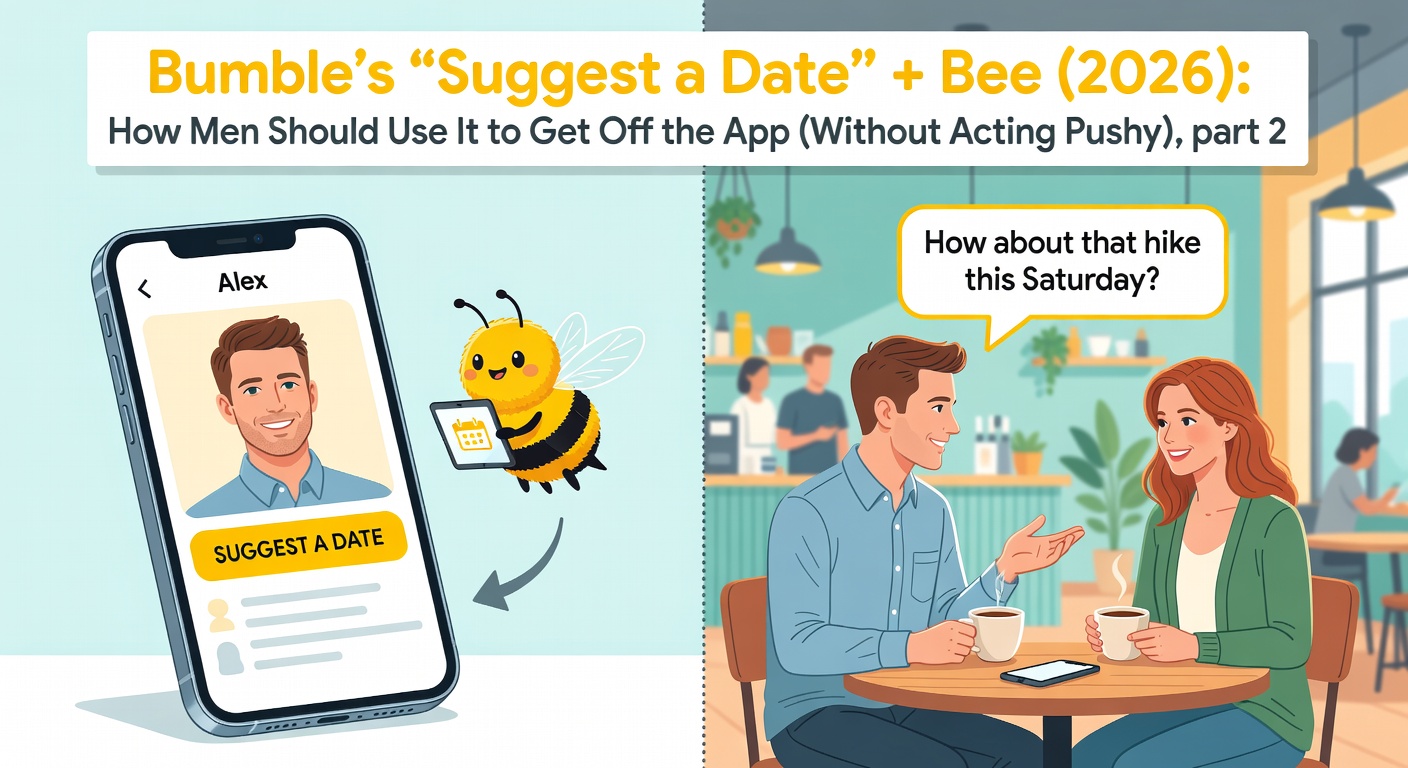
- “You seem easy to talk to. Want to grab a quick drink this week — Wed or Thu?”
- “If you’re free, I’m doing coffee at [place] this weekend. Sat afternoon or Sunday morning work better?”
Why it works psychologically:
- Two options signals leadership without pressure.
- “Quick” keeps it low stakes.
- It feels adult, not needy.
Bee (Dates, powered by Bee): What It Means for Men (Even If You Don’t Have It)
Right now, Bee is limited access (invited members in NYC). (support.bumble.com)
But the direction is obvious: Bumble wants more structured matching and fewer wasted cycles.
What you should do now (to match the direction Bumble is moving)
Even on regular Bumble, behave like the platform is scoring you on:
- responsiveness
- clarity
- date conversion
- low complaint risk (creepy/pushy flags)
So optimize for:
- shorter chats
- clearer plans
- fewer “what are you looking for?” interrogations
- less sexual escalation early
Profile Guidance (2026): Don’t Let Bumble “Fix” Your Profile in the Wrong Direction
Bumble also announced Profile Guidance in the same Feb 26, 2026 release. (ir.bumble.com)
Whenever an app introduces profile “help,” most men make the same mistake: they use it to become more generic.
Your goal is not “most broadly appealing.”
Your goal is most believable + easiest to say yes to.
A practical Profile Guidance checklist (what you should actually aim for)
Use these 5 profile anchors (they outperform “I like travel and tacos”):
- Face photo that looks like you on a good day (not your best day in 2019)
- Full-body photo (normal setting, not gym mirror)
- Social proof (one photo where it’s clear you have friends / a life)
- One interest that creates an easy first date (coffee, tacos, bookstores, climbing, live music)
- One line that shows standards (not requirements)
Examples of standards that aren’t cringe:
- “Big fan of simple first dates: one drink, good conversation, home by 10.”
- “I’m not a huge texter — I’d rather meet and see if it clicks.”
Standards = reality. Reality = trust. Trust = dates.
What to Message in 2026 (Bumble Edition): The 3-Part Opener That Converts
Bumble is “clarity”-maxxing because boring small talk is dying.
Use this opener framework:
- Receipt (proof you read her profile)
- Micro-opinion (a real preference)
- Easy question (one step to answer)
Examples:
- “That [restaurant] pic is a solid choice. I’m biased toward ramen > sushi most days. What’s your go-to order there?”
- “You seem like you actually get outside (rare). I’m trying to hike more this spring — what trail was that?”
Key constraint: keep it to 2 short sentences + 1 question.
Frank Verdict: Will These Updates Help Average Men?
Yes — if you already behave like a functional adult.
Bumble’s own framing is that these tools exist because conversations stall and people want clearer support to take the next step offline. (ir.bumble.com)
But no feature fixes:
- poor photos
- vague intent
- over-texting
- fear of asking her out
- “pen pal” habits
The brutal truth
If you consistently fail on Bumble, it’s usually one of these:
- you’re matching women who are out of your league for your current profile
- your openers are generic
- you delay the date ask too long
- your date ask is vague (“we should hang sometime”)
“Suggest a Date” won’t save that.
But it will reward guys who are already close and just need a cleaner trigger to move things forward.
Your 7-Day Action Plan (No Fluff)
Do this for one week:
- Update profile with:
- 1 clean face photo
- 1 full-body
- 1 social photo
- 1 “easy first date” interest
- Start 10 conversations using the receipt + micro-opinion + question opener.
- Use Suggest a Date (if you have it) only when:
- she’s replied normally
- you’re within the first 2–6 messages
- Ask her out with:
- one plan
- two time options
- low pressure language
- Track (quick notes app is fine):
- matches → replies
- replies → dates scheduled
- dates scheduled → dates attended
If you can’t measure it, you can’t improve it.
Conclusion: Bumble Is Building for “Clarity Guys.” Become One.
Bumble’s 2026 product direction is a loud signal: the apps are tired of dead chats, and women are tired of ambiguous men.
Suggest a Date is Bumble trying to productize what works: direct intent, low-pressure leadership, and faster movement from match to meeting. (ir.bumble.com)
Bee (Dates) is Bumble testing a future where the app curates more and you swipe less — but your real job stays the same: show up as a trustworthy, grounded man who can make a simple plan. (support.bumble.com)
Don’t “game” these features.
Use them to do the thing most men avoid — make the date happen.