AI on Dating Apps in 2026: A Practical Strategy for Men (Without Sounding Like a Bot)
AI on Dating Apps in 2026: A Practical Strategy for Men (Without Sounding Like a Bot)
Dating apps are in their “trust and fatigue” era—and AI is the new accelerant.
On one side, major platforms are pushing AI features to reduce swipe fatigue and improve match quality (Tinder’s AI “Chemistry,” Hinge’s AI-inspired conversation starters). (techcrunch.com) On the other side, more singles are already using outside tools like ChatGPT to write profiles, messages, and even plan dates—26% of U.S. singles per the Match Group + Kinsey Institute survey, a major jump year-over-year. (news.iu.edu)
And then there’s the stranger third lane: people “dating” AI itself. A recent report cited a ZipHealth survey claiming 26% of Gen Z respondents had romantic/sexual interactions with AI. (techradar.com)
If you’re a man dating in 2026, your edge isn’t “better lines.” It’s a better system: use AI as a tool, not a personality—and build real-world momentum fast.
This article gives you a field-tested framework that works because it respects the psychology of modern dating: attention scarcity, safety concerns, burnout, and the rising suspicion that “this person might not even be real.”
The 2026 Reality: AI Is Everywhere—and Women Can Feel It
Three trends are colliding:
-
Apps are adding AI features to keep users from leaving
- Tinder is testing an AI feature called Chemistry to reduce swipe fatigue/burnout. (techcrunch.com)
- Hinge introduced AI-inspired Convo Starters to help people stop overthinking first messages. (techradar.com)
-
Singles are using AI independently (outside the apps)
- Match + Kinsey Institute data: 26% of singles using AI while dating. (news.iu.edu)
-
Dating burnout is real
- “Dating fatigue” is mainstream enough that major outlets are covering people shifting away from apps and leaning more on friends/social circles. (lemonde.fr)
- Pew’s work shows ghosting and negative experiences are common in modern dating, and it shapes how people interpret messages and intent. (pewresearch.org)
Bottom line: many women (and men) now assume:
- your opener might be AI,
- your profile might be AI,
- your vibe might be curated,
- your intentions might be unclear,
- and the app experience might not be worth the effort.
So the winning move is credible clarity + low-pressure leadership.
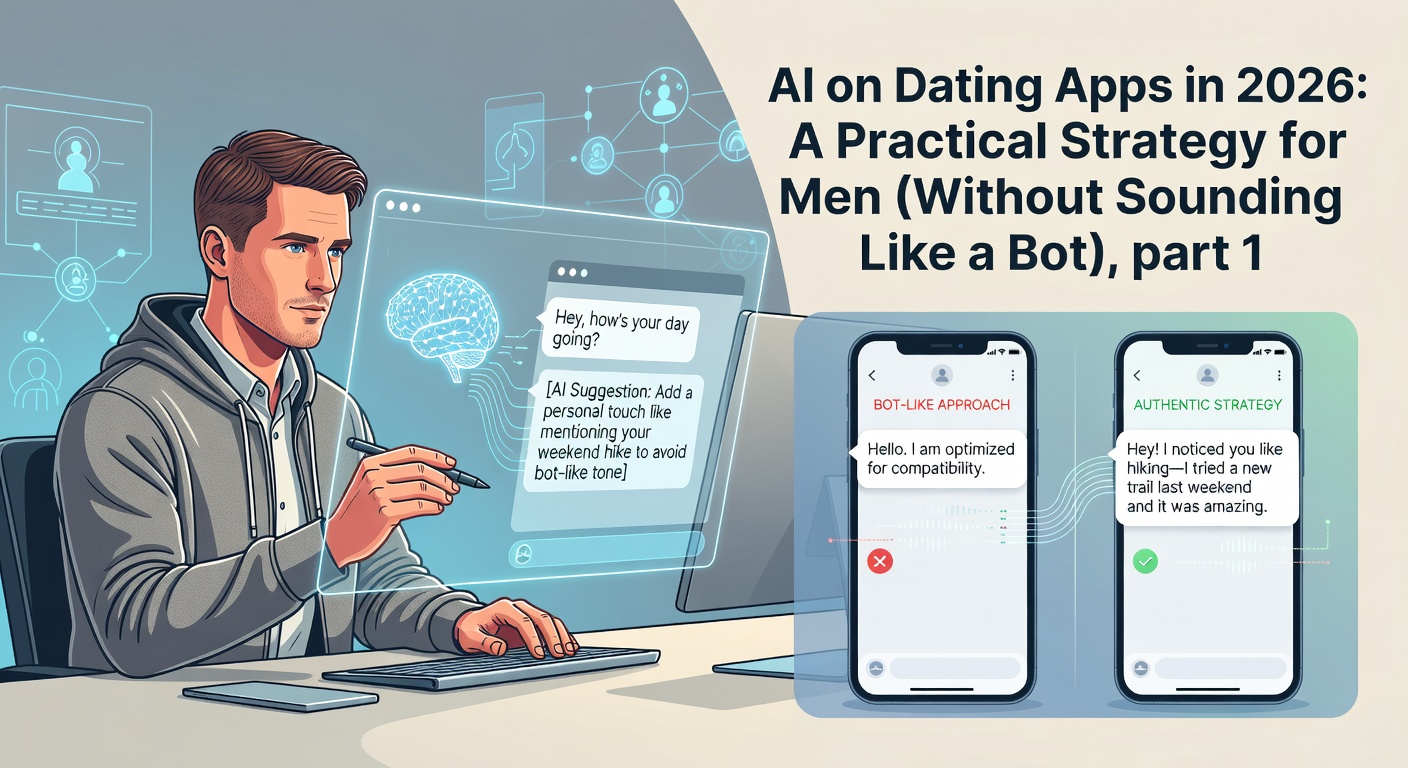
The DateWise Rule: AI Can Help You Sound Clearer—Not “Cooler”
Here’s the line you don’t cross:
- Good use: AI helps you communicate truthfully, simply, specifically
- Bad use: AI helps you perform a character you can’t sustain
If you use AI to act “wittier,” you create a trap:
- She likes “text-you.”
- Then she meets “real-you.”
- Attraction drops because inconsistency reads as deception, even if your intentions were harmless.
Your goal isn’t to impress. It’s to reduce uncertainty and increase trust—fast.
A Practical 4-Step System: Profile → Message → Call/Voice → Date
This system is built for 2026 conditions: low attention, high skepticism, high churn.
Step 1: Build an “anti-AI” profile (specific > polished)
AI-generated profiles are usually:
- generic,
- over-written,
- full of vague values (“adventure,” “good vibes,” “sarcasm”),
- and weirdly symmetrical.
To look real, you want asymmetry: specific details that are hard to fake.
Use this checklist:
- 3 concrete anchors (places, activities, routines)
- “Wednesday lifting + Sunday farmers market”
- “Trying every ramen spot in the city”
- 1 social proof cue (without bragging)
- “I host a monthly game night”
- 1 preference filter (kind, not demanding)
- “If you’re also trying to date intentionally, we’ll get along.”
If you use AI here, use it like an editor:
- “Make this 20% shorter.”
- “Remove cringe lines.”
- “Make it more specific and less generic.”
Do not ask it to “make me sound charming.” That’s how you get Bot Energy.
Step 2: Message like a human (and like you have a life)
Hinge is literally building AI tools to stop people from sending low-effort first messages. That should tell you how bad the baseline is. (techradar.com)
Your message framework:
The 12-Word Opener
- One specific reference to her profile
- One low-pressure question
- One small self-reveal
Examples:
- “You mentioned salsa lessons—are you a beginner or already dangerous?”
- “That hiking photo: was it a weekend trip or a big planned one?”
- “You’re into thrillers—give me one I won’t see coming.”
Why it works:
- It proves you read.
- It creates an easy reply.
- It shows personality without performing.
Avoid:
- compliments about looks (too common, low signal)
- paragraphs (too high investment too early)
- interrogations (feels like an interview)
Step 3: Use voice strategically (because text is a weak signal)
Hinge data (reported by CNBC) found that sending a voice note was 48% more likely to lead to a date. (cnbc.com)
Why voice works in 2026:
- it’s harder to fake than text,
- it communicates warmth and confidence,
- it reduces “is he real?” suspicion,
- it helps chemistry show up earlier.
When to send a voice note
- after she replies at least once
- when the vibe is positive and playful
- when you can keep it under 15–25 seconds
Voice note script (simple)
- Say her name (or reference her prompt)
- 1 sentence of context
- 1 light question
Example:
“Okay, I’m biased, but your ‘worst travel story’ prompt made me laugh. Quick question—are you more ‘plan everything’ or ‘figure it out’ on trips?”
The goal isn’t radio-host charm. It’s calm, socially grounded energy.
Step 4: Convert to a date fast (before burnout wins)
Your biggest enemy isn’t another guy. It’s her deciding apps are annoying and disengaging.
So you escalate smoothly:
After 6–12 total messages:
- Suggest something simple, specific, and time-bound.
Use the Two-Option Close:
- “You seem fun—want to continue this over coffee this week? Wed or Sat?”
This works because:
- it’s decisive (attractive),
- it’s low pressure,
- it makes replying easy.
If she hesitates, don’t push. Offer a small “bridge”:
- “No worries—want to swap a quick voice note or do a 10-minute call first?”
This respects safety/comfort without stalling forever.

How to Use AI Without Getting “Chatfishing” Vibes
AI “chatfishing” is now a known fear: people worry they’re talking to a bot or to someone outsourcing their personality. (tech.yahoo.com)
Here’s the ethical line DateWise recommends:
Use AI for:
- tightening your writing (clarity, brevity)
- generating date ideas based on logistics
- reflecting your tone back to you (“Does this sound intense?”)
- spotting accidental red flags (“Is this too sexual too early?”)
Don’t use AI for:
- pretending to have interests you don’t have
- fake vulnerability (“deep” stories you don’t mean)
- extended AI-written conversations
- anything you couldn’t comfortably say out loud on a first date
Rule of thumb: if a message would feel weird to read aloud, rewrite it.
The “Trust Stack” (Modern Dating Psychology in One Framework)
In 2026, attraction is still attraction—but trust is the multiplier.
Build trust in layers:
- Consistency
- profile and messages match your real personality
- Specificity
- details reduce uncertainty and “player/bot” suspicion
- Calibration
- you adjust intensity to her pace
- Leadership
- you propose plans without pressure
- Follow-through
- confirm, show up on time, keep it simple
This is why “AI-polished” men lose: polish without follow-through reads as manipulation.
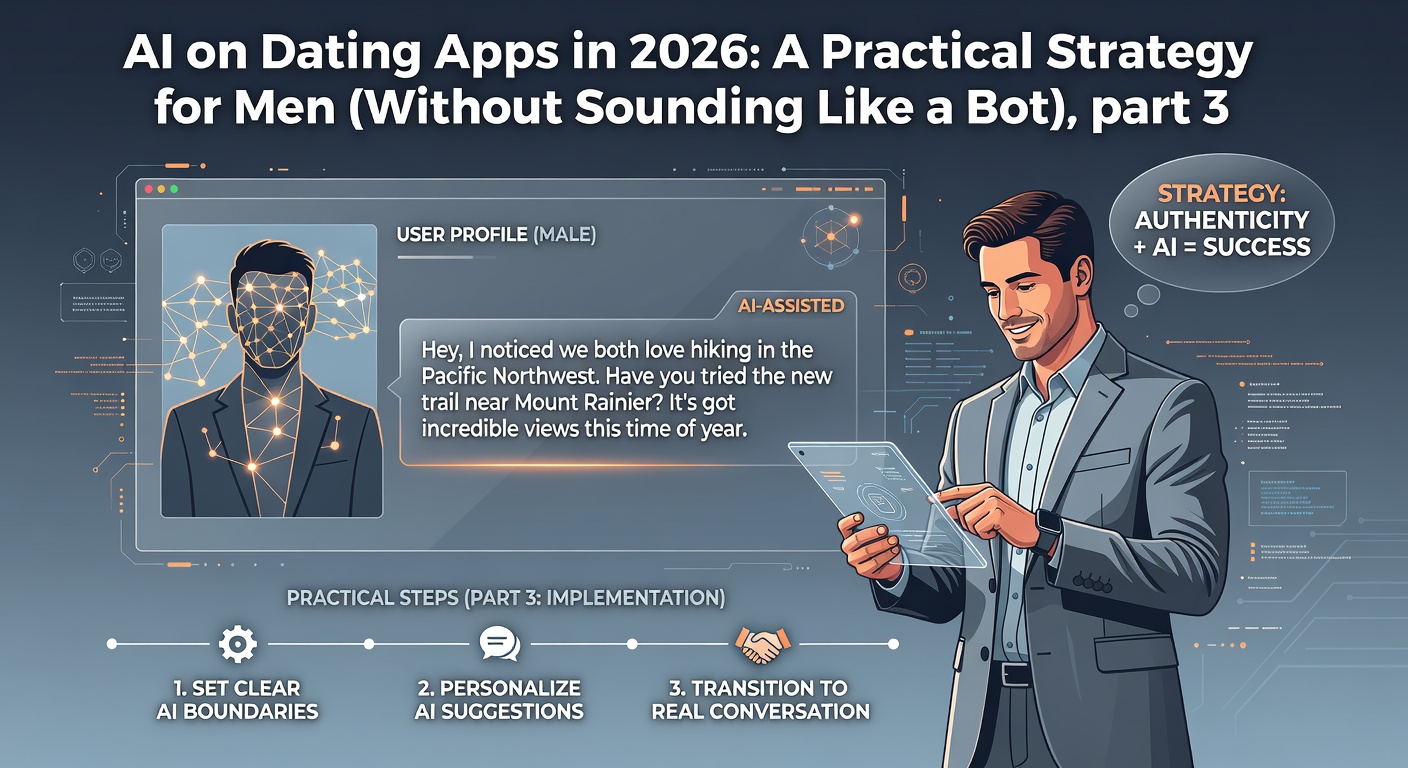
A Simple 7-Day Anti-Burnout Plan (That Actually Increases Dates)
Men get stuck in endless swiping. Your job is to create constraints.
Day 1: Profile cleanup
- remove anything generic
- add 3 specifics
- add 1 clean full-body photo
- add 1 “social” photo (not a club)
Days 2–6: 20 minutes/day
- 10 minutes swiping with intention (not boredom)
- 10 minutes messaging only matches who replied
Day 7: Close
- ask out the 2 best conversations
- archive dead chats (stop zombie messaging)
This keeps your brain from associating dating with endless effort / no payoff, which is how burnout forms.
Conclusion: The Winning Strategy in 2026 Is “Human, Fast, and Real”
Dating apps are evolving because users are tired—and AI is being positioned as the fix. Tinder is testing AI to fight swipe fatigue. Hinge is adding AI conversation help. (techcrunch.com) Meanwhile, a meaningful chunk of singles are already using AI on their own—26% per Match/Kinsey—and that number is big enough to change the culture of trust on apps. (news.iu.edu)
So here’s the modern play:
- Use AI as your editor, not your identity.
- Build a profile that feels specific and lived-in.
- Message with simple human intent.
- Add voice to prove you’re real.
- Move to a date before the app experience decays.
That’s not game. That’s just how you date well in a world where everyone is one update away from sounding fake.