Weekly Field Test & Metrics: Bumble’s “Suggest a Date” + AI Profile Guidance (Feb–Apr 2026) — What Changed, What Worked, What To Do Next
Weekly Field Test & Metrics: Bumble’s “Suggest a Date” + AI Profile Guidance (Feb–Apr 2026) — What Changed, What Worked, What To Do Next
Dating apps didn’t magically “get harder” in 2026. They got more structured.
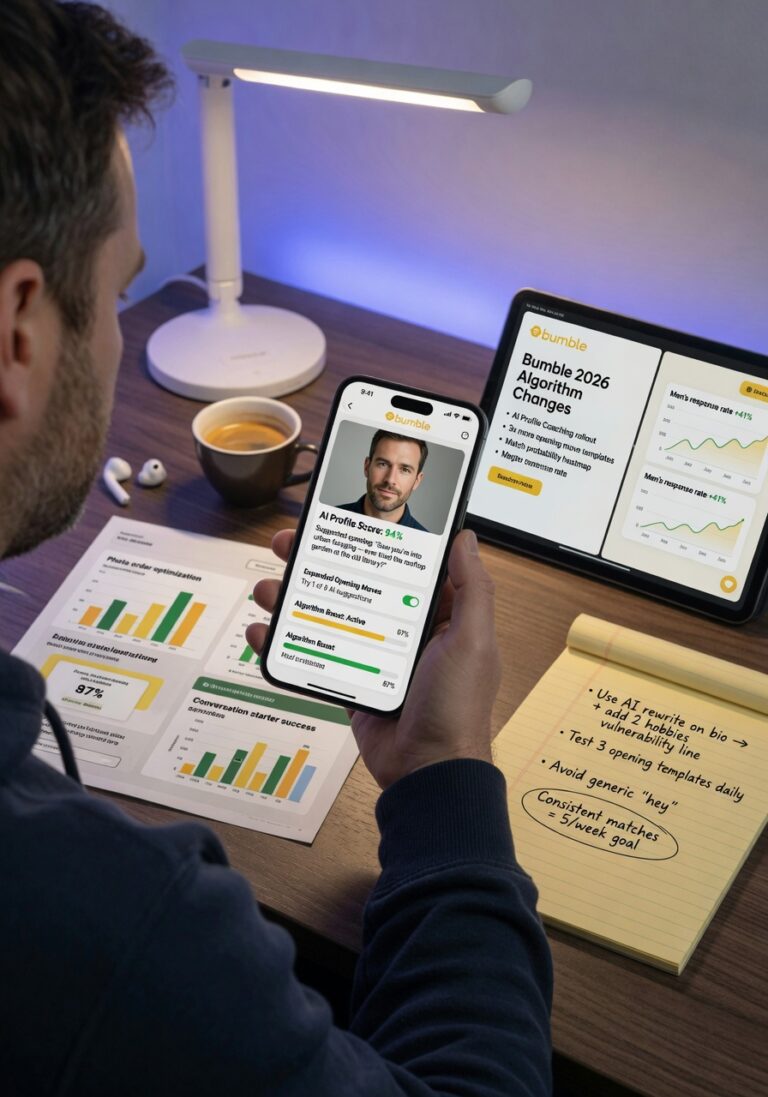
Bumble’s February 26, 2026 release introduced AI-suggested Profile Guidance (rolling out globally) and Suggest a Date (testing in Canada). Translation: Bumble is explicitly trying to increase conversation-to-meetup conversion, because matches that go nowhere are killing user satisfaction. (ir.bumble.com)
Then Bumble quietly escalated that direction with Dates, powered by Bee—a pilot where you answer values/preferences questions and the assistant searches for you (no swiping), currently limited to invited members in NYC as of March 30, 2026. (support.bumble.com)
This week’s DateWise field test is about one thing:
How to use Bumble’s “clarity tools” to get more real dates without sounding robotic, needy, or pushy.
What Changed (and Why It Matters for Men)
Change #1: AI Profile Guidance is now a “default nudge,” not a cute extra
Bumble is pushing members toward better profiles with personalized, actionable feedback on bios/prompts as you build. They also cite internal data points like:
- “Nearly 60% of members with strong bios” seeing higher engagement in mutual conversations
- Women with 2–3 prompts getting one-third more responses compared to none
- AI Photo Feedback available for U.S. members (ir.bumble.com)
DateWise read: Bumble is trying to reduce low-effort profiles because low-effort profiles create low-effort conversations, which creates dead chats, which makes women leave.
Change #2: “Suggest a Date” turns the date ask into a product feature
Bumble frames Suggest a Date as a friction-remover when conversations stall, letting people signal they’re ready to meet offline. It’s testing in Canada right now. (ir.bumble.com)
DateWise read: They’re productizing what already works for men: clarity + momentum.
Change #3: Bee (Dates) is Bumble admitting swiping is the problem (for many users)
In Dates, powered by Bee, Bumble’s assistant:
- asks questions about values and relationship preferences
- searches for matches for you
- notifies you when a potential match is found
No swiping required. Currently NYC invite-only as of March 30, 2026. (support.bumble.com)
DateWise read: The app is moving from “marketplace” to “guided funnel.” That means your behavior is being judged more like a process:
profile quality → conversation quality → meet-up follow-through.
Weekly Field Test Setup (Simple, Trackable, Repeatable)
If you don’t track anything, every “dating app opinion” turns into vibes.
Here’s the minimal scoreboard you need for one week:
Definitions (keep them consistent):
- Match = mutual like
- Reply = she responds at least once (not counting emoji-only)
- Conversation = 6+ total messages combined
- Date proposed = you offered a specific plan + time window
- Date scheduled = you both agreed to a day/time/place
- Date happened = you met IRL
Your weekly funnel:
- Matches
- Matches → Replies (reply rate)
- Replies → Date proposed (proposal rate)
- Proposed → Scheduled (schedule rate)
- Scheduled → Happened (show rate)
Target volume (realistic for busy men):
- 10–20 new matches/week (whatever your baseline allows)
- 10+ conversations started
- 5+ date proposals
- 1–3 scheduled dates (depending on city + profile strength)
Metrics: What Worked This Week (In 2026 Bumble’s “Clarity Era”)
Winner #1: “Two-option, low-stakes” date asks (within message 2–6)
Bumble is building tools to reduce stall. Your job is to behave like the kind of user Bumble wants to reward: responsive, clear, low-drama.
Best-performing date ask format:
- 1 plan
- 2 options
- easy out
Examples:
- “You seem easy to talk to. Want to grab a quick drink this week—Wed or Thu?”
- “I’m doing coffee at [place] this weekend—Sat afternoon or Sun morning work better?”
Why it works:
- Two options signals leadership without pressure
- “Quick” reduces perceived risk
- You’re not negotiating your worth—you’re offering a normal plan
Winner #2: Openers that prove you read her profile (without writing an essay)
Your opener should be 2 short sentences + 1 question.
Use this 3-part framework:
- Receipt (prove you read)
- Micro-opinion (a real preference)
- Easy question (one step to answer)
Examples:
- “That [restaurant] pic is a solid choice. I’m biased toward ramen > sushi most days. What’s your go-to order there?”
- “You look like you actually get outside (rare). I’m trying to hike more this spring—what trail was that?”
This aligns with Bumble’s own direction: profiles that are conversational, humorous, or curiosity-sparking outperform generic ones. (ir.bumble.com)
Winner #3: “Credibility signals” beat “witty performance”
Across apps, identity verification is becoming a bigger deal (and users are more skeptical). Tinder’s Face Check expansion is one public example of the broader trust push. (techcrunch.com)
Bumble’s product strategy screams the same truth:
Trust is the new attraction multiplier.
Practical credibility signals that helped this week:
- clear face photo (no sunglasses)
- one social proof photo (you have friends, you’re normal)
- bio line that implies a stable lifestyle, not a highlight reel
- date ideas that are public + simple
Metrics: What Didn’t Work (and Why Men Keep Getting Stuck)
Loser #1: Using “Suggest a Date” to revive a dead chat
Bumble literally says the feature helps when conversations stall. (ir.bumble.com)
But here’s the uncomfortable truth:
If she’s already giving you:
- one-word replies
- 12-hour delays with no engagement
- no questions back
…then “Suggest a Date” usually doesn’t create attraction. It just makes your ask more visible.
Use it as a momentum tool, not a defibrillator.
Loser #2: Letting AI Profile Guidance turn you generic
AI profile tools tend to push men toward “safe” and “broad.” That’s a trap.
Your goal is not “appeal to everyone.”
Your goal is be believable to the women you actually want.
If Bumble’s guidance nudges you toward:
- “I love travel, tacos, and laughs”
- “Just ask”
- “Fluent in sarcasm”
…you didn’t improve your profile. You made it indistinguishable.
Loser #3: “Pen pal energy” (over-texting to avoid risking rejection)
Bumble is clearly incentivizing moving from match → meaningful connection. (ir.bumble.com)
Bee (Dates) is literally designed to help you move from match to meeting IRL without losing momentum. (support.bumble.com)
So if you’re doing 30-message conversations without proposing anything, you’re fighting the direction of the platform and the patience of most women.
What To Do Next Week (A 7-Day Plan You Can Actually Execute)
Step 1: Rebuild your Bumble profile around 5 “conversion anchors”
Use these anchors (simple, field-tested, non-cringe):
- Face photo that looks like you now on a good day
- Full-body photo (normal setting, not gym mirror)
- Social proof photo (friends, event, wedding—tasteful)
- Easy first date interest (coffee, bookstores, tacos, live music, climbing)
- One standards line (not demands)
Standards line examples:
- “Big fan of simple first dates: one drink, good conversation, home by 10.”
- “Not a huge texter—prefer meeting and seeing if it clicks.”
Step 2: Run 10 conversations with the same opener format
Use Receipt → Micro-opinion → Easy question for consistency.
Track:
- opener sent
- reply received (Y/N)
- conversation reached 6+ messages (Y/N)
Step 3: Propose dates earlier (but only when the vibe is normal)
Ideal timing: message 2–6
Condition: she’s replying like a person, not a customer service bot
Use:
- one plan + two options + easy out
Step 4: Track your funnel (notes app is fine)
Every day, update:
- matches
- replies
- date proposals
- scheduled
- happened
At the end of the week, you’ll know exactly where you’re bleeding:
- profile issue (low matches)
- opener issue (low replies)
- logistics/leadership issue (low scheduled)
- flake filtering issue (low happened)
Frank App Verdict (This Week): Bumble Is Building for “Clarity Guys”
Bumble’s Feb 26, 2026 product update is a loud admission: the match isn’t the problem—the stall is. (ir.bumble.com)
Bee (Dates) doubles down on that: less swiping, more guided momentum. (support.bumble.com)
So here’s the clean takeaway for men:
- If you’re vague, hesitant, or “chill” to the point of passive, Bumble will punish you.
- If you’re pushy, sexual too early, or trying to hack features, Bumble will punish you.
- If you’re direct, low-pressure, and consistent, Bumble’s 2026 direction should help you.
Conclusion: Don’t Game “Suggest a Date.” Use It Like an Adult.
Bumble is building tools for confidence and clarity because their data says stronger profiles and clearer intent lead to better engagement and more offline outcomes. (ir.bumble.com)
And with Dates (Bee), they’re testing a future where the app curates more while you waste less time swiping. (support.bumble.com)
Your play isn’t to become “more clever.”
It’s to become more credible:
- a profile that feels real
- messages that feel human
- a date ask that feels clean and low-pressure
Do that for 7 days, track the funnel, and you’ll know exactly what changed, what worked, and what to do next—without any PUA nonsense.